Sign content credentials that travel with every photo, video, and document you publish
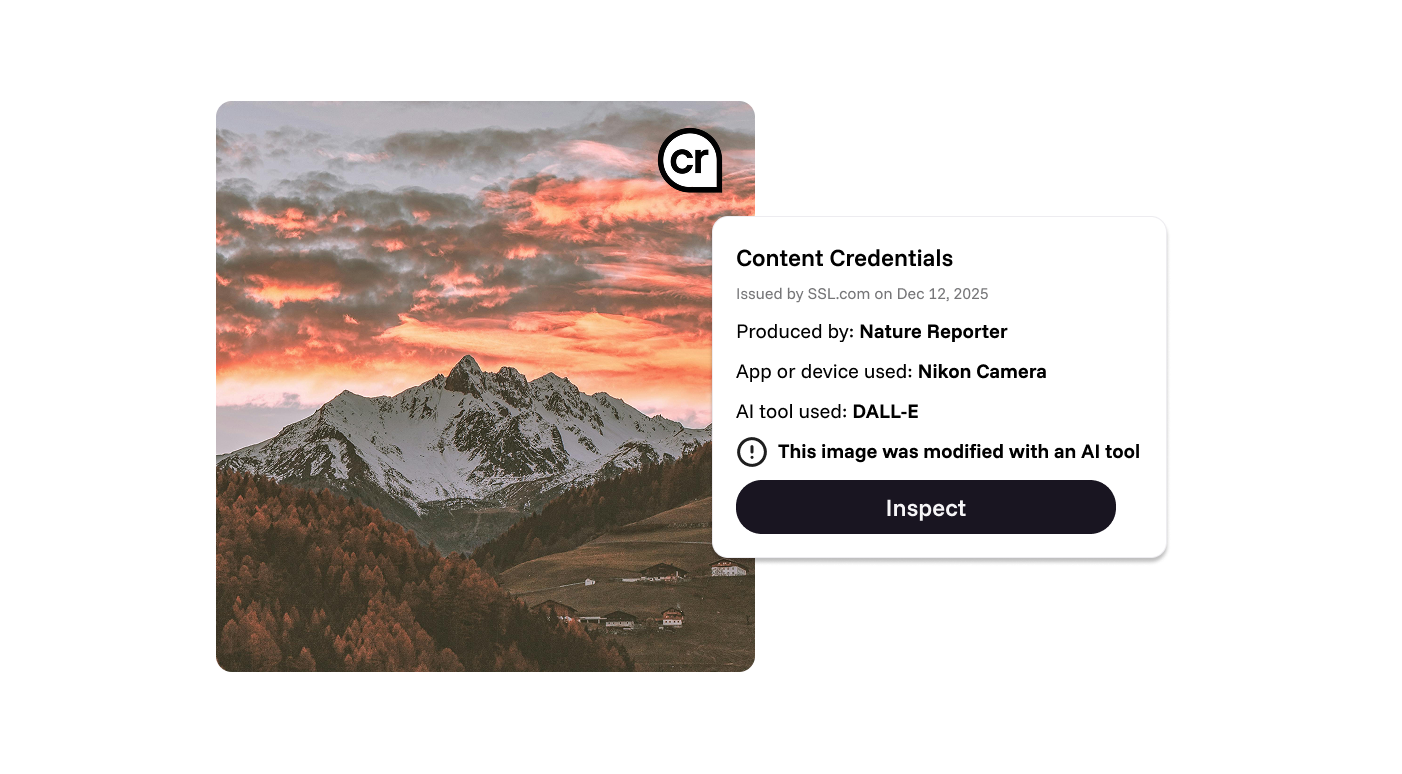
A C2PA Certificate lets you attach a cryptographically signed provenance record, a “content credential,” to any media file. Anyone who receives the file can verify its origin, check whether it’s been altered, and see an auditable chain of custody from creation to distribution. Built on the open C2PA standard, backed by Adobe, Google, Microsoft, BBC, Reuters, Sony, Nikon and the broader Content Authenticity Initiative.
Start Free
What is a C2PA Certificate?
The cryptographic anchor for content provenance.
A C2PA (Coalition for Content Provenance and Authenticity) Certificate is a digital certificate used to sign a C2PA manifest, the structured provenance record embedded in a media file. The certificate proves that the manifest was created by the named entity and hasn't been tampered with since signing.
When a platform, viewer, or tool inspects a content credential, it validates the C2PA certificate signature, confirming the credential is authentic and unaltered.
SSL's C2PA Products
C2PA Platform Certificates
C2PA Compliant claim signing certificates for online platforms. Allows Generator Products to sign C2PA claims. One certificate is need per Generator Product.
C2PA Device Certificates
C2PA Compliant Certificates delivered through our high availability API. Allows devices such as cameras, cam recorders, mobile phones, microphones or apps to sign C2PA claims.
C2PA Time Stamping Service
Scalable C2PA Compliant Time Stamping Authority (TSA). RFC 3161 compliant API. Allows long term validation and ensures content can be validated even after a certificate is revoked or expired.
SSL Provenance API
A fully managed SaaS (API) to add & sign C2PA + CAWG manifests to digital assets. Simplify your implementation by creating, editing & signing C2PA + CAWG manifests for your assets via a simple API calls.
CAWG Certificates
SSL CAWG-compliant certificates compatible with the IPTC Verified News Publisher Trust List. Add an additional attribution signature as an individual & or organization (e.g., journalist, media company).
Free & Premium Tiers
SSL offers two different tiers. The Premium Tier is meant for platforms that are ready to launch at scale while the free tier allows early stage ventures to get started for free.
| Feature | Free No cost | Premium Best value |
|---|---|---|
| C2PA Claim Signing Certificates — assurance Level 1 | 1 certificate, valid for 1 year | Buy as many as needed |
| Free re-issuance | –Not included | Yes |
| Time stamping requests (TSA) for long-term validation | 10,000 timestamps included per year; on-demand cost for additional timestamps | Buy as many as needed at reduced bulk rate |
| Issuance via SSL.com Portal | Yes | Yes |
| Issuance via SSL.com API | –Not included | Yes |
| Company name available for public listing on the ssl.com website | Yes (we reserve the right not to list the company on this site) | Optional |
| C2PA Claim Signing Certificates — assurance Level 2 | –Not included | As many as needed |
| C2PA Claim Signing Certificates for devices (Level 2) | –Not included | As many as needed |
| C2PA Conformance program support | –Not included | Included |
| Enterprise Support Services | –Not included | Available |
| Access to C2PA specialists & solution architects | –Not included | Available |
| CAWG Certificates | At list price | Opportunity to become a CAWG reseller |
| Issuing CA | Issued from a Free Tier SSL.com C2PA Intermediate (Issuing CA) | Issued from a premium SSL.com C2PA Intermediate |
| Warranty coverage | –Not included | High Assurance |
The Free Tier requires a valid C2PA conformance record ID at application. Premium is the path if you need Level 2, API access, device certificates, conformance program support, or C2PA advisory.
Get Started
Process
Here are the steps you’ll need to go through to get stated with C2PA in your products:
1. C2PA Conformance
As a C2PA Trusted CA, SSL is required to only issue certificates for tools and devices that have passed C2PA Conformance. Find more details about the conformance process here. If you choose our premium tier we’ll be happy to support you with templates and guidance.
2. Certificate issuance
SSL issues your C2PA Certificate via our portal or API after validating your organization's identity and receiving you CSR (Certificate Signing Request).
3. Integrate into your workflow
Use the certificate in your generator product to sign content manifests.
4. Add a trusted timestamp
Request an RFC 3161 timestamp from SSL's Trusted TSA and add it to the manifest so that your content stays valid even after the certificate expires.
5. Content verification
Recipients, platforms, and tools verify the credential signatures against the C2PA Trust List, confirming origin, checking for alterations, and reading any AI disclosure
Compliance & standards
C2PA Specification (v2.x)
SSL issues certificates per the C2PA specification. C2PA Claim Signing certificates from Trust List CAs are the norm since C2PA 2.2.
C2PA Trust List
As of 1 January 2026, the C2PA Trust List replaced the Interim Trust List. Validators are no longer required to validate content signed via the Interim Trust List.
RFC 3161 (Time Stamping)
Trusted timestamps from SSL's TSA provide long-term validation for signed manifests
EU AI Act
Requires disclosure of AI-generated content. C2PA manifests provide a standardized, machine-readable disclosure mechanism.
Content Authenticity Initiative (CAI)
SSL is a CAI member. C2PA certificates issued by SSL are part of the CAI trust framework.
Frequently asked questions
Yes. Since June 2026 the SSL C2PA Free Tier includes one Level 1 Claim Signing Certificate (valid for 1 year) and 10,000 trusted timestamps per year, issued via the SSL portal. You need to apply with a valid C2PA conformance record ID. If you need Level 2 certificates, device certificates, or conformance support contact us for our Premium tier.
A C2PA Certificate signs the content manifest, proving it is coming from a conformant generator (e.g., a tool or device). A CAWG Identity Assertion embeds your verified organizational or personal identity inside the manifest. They complement each other: use both for maximum attribution and trust.
Without a trusted timestamp, a manifest stops being valid once the signing certificate expires or is revoked. A timestamp coming from a Trusted Time Stamping Authority like SSL lets validators confirm the claim was signed while the credential was valid, so the manifest can be validated indefinitely. See the Time Stamping Authority product page.
Yes, you can sign existing content with a C2PA manifest. However, provenance established at the point of creation is more authoritative than retroactive signing. Best practice is to sign at capture or creation.
C2PA supports JPEG, PNG, TIFF, WebP, MP4, MOV, MP3, WAV, HEIC, PDF, live video, text and others. Support is expanding as the standard matures.
Recipients can verify content at verify.contentauthenticity.org without any special software. C2PA-aware tools (Adobe apps, LinkedIn, browsers via extensions) display credentials inline.
Related products
CAWG Certificates
Add verified identity attribution inside your C2PA manifest
Time Stamping Authority (TSA)
Trusted RFC 3161 timestamps for long-term manifest validation
VMC (Verified Mark Certificate)
Authenticate your brand in email alongside content distribution
Additional Resources
C2PA: Enterprise Content Authenticity Solutions
Learn how SSL.com's C2PA certificates help enterprises authenticate digital content, prove provenance, and protect against AI-generated misinformation at scale.
A Guide to Content Authenticity Solutions
This guide covers how C2PA Content Credentials work, the certificate types available through SSL, the two assurance levels that determine which certificate fits your use case, and the step-by-step process for obtaining a certificate.
The Trust Crisis: Why C2PA Exists
Media attribution and provenance have become a growing issue, especially on social media, in recent years.